
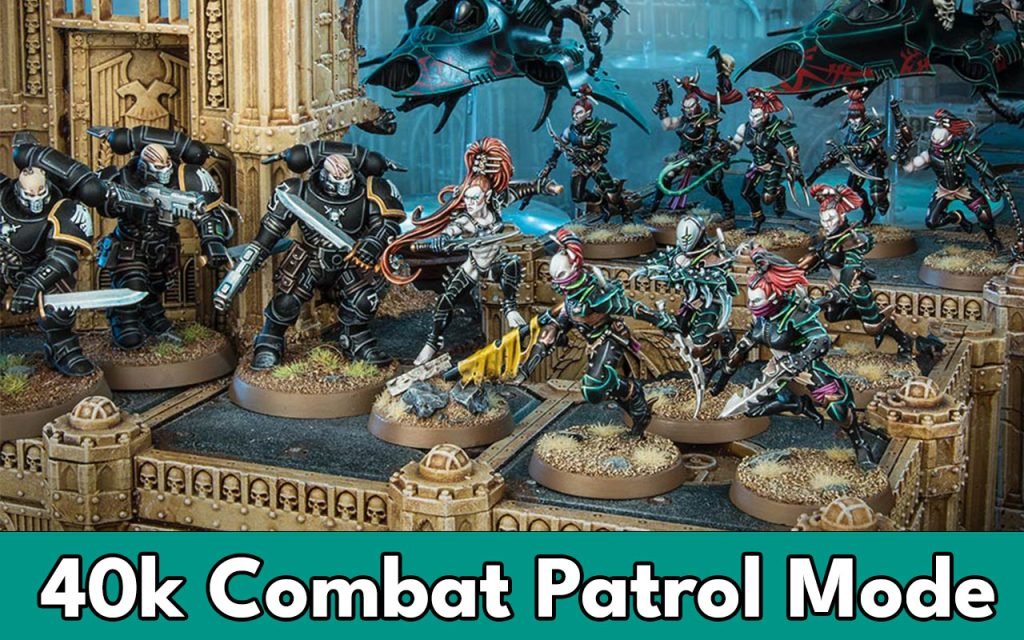
The Combat Patrol game mode is a new way in which players can take part in Warhammer 40k. But what 40k Combat Patrol? Why would you be interested in this game mode? And, if you were keen to try it, how would you go about getting started?
It is a good job that I, your ever-faithful servant in the navigation of the new 10th Edition world that we live in, am here to answer all the questions.
Before we get started, if you are unfamiliar with the changes and rule updates for the 10th Edition, we have got an article on the new Core Rulebook that will explain the whole thing for you! If you are familiar, however, let’s press on to the juicy stuff.

Shop Combat Patrol Boxes
Ready to pick up your Combat Patrol box? Here are three of the most popular options — each a complete, ready-to-play army straight out of the box.




Not sure which faction suits you? Browse all Combat Patrol boxes, or read the faction breakdown below.
Table of Contents (click to expand)
- What is the 40k Combat Patrol Game Mode?
- The rules for 40k Combat Patrol and what a Combat Patrol is
- 40k Combat Patrol Rules by Faction — Playstyle Breakdown
- Space Marines Combat Patrol Rules
- Death Guard Combat Patrol Rules
- Necrons Combat Patrol Rules
- T’au Empire Combat Patrol Rules
- Tyranids Combat Patrol Rules
- Blood Angels Combat Patrol Rules
- Space Wolves Combat Patrol Rules
- Dark Angels Combat Patrol Rules
- Black Templars Combat Patrol Rules
- Grey Knights Combat Patrol Rules
- Adeptus Custodes Combat Patrol Rules
- Aeldari Combat Patrol Rules
- Drukhari Combat Patrol Rules
- Chaos Space Marines Combat Patrol Rules
- Thousand Sons Combat Patrol Rules
- Chaos Daemons Combat Patrol Rules
- Orks Combat Patrol Rules
- Adepta Sororitas Combat Patrol Rules
- Adeptus Mechanicus Combat Patrol Rules
- Leagues of Votann Combat Patrol Rules
- World Eaters Combat Patrol Rules
- Astra Militarum Combat Patrol Rules
- Genestealer Cults Combat Patrol Rules
- Why would you play the 40k Combat Patrol Game mode?
- Frequently Asked Questions — 40k Combat Patrol Rules
- What is Combat Patrol in Warhammer 40,000?
- How many points is a Combat Patrol army?
- Do you need a Codex to play Combat Patrol?
- Can any Warhammer 40k faction play Combat Patrol?
- Is Combat Patrol good for beginners?
- How long does a Combat Patrol game take?
- What is the difference between Combat Patrol rules and standard 40k rules?
- Where can I find the Combat Patrol rules PDF for my faction?
Divulgación de enlaces de afiliados
Age of Miniatures cuenta con el apoyo de los lectores. Al comprar a través de los enlaces de nuestro sitio, podemos ganar una comisión de afiliación. Más información.
What is the 40k Combat Patrol Game Mode?
The Combat Patrol game mode is based around the Combat Patrol starter boxes (we got an article covering all Combat Patrol Boxes)
While each Combat Patrol box is ideal for starting your 40k collection, they have now been adapted to work as stand-alone armies that players can use to get straight into playing. Not only has the selection of models in each box been updated, but Games Workshop has also made free PDFs for each Combat Patrol that includes data sheets, stratagems, enhancements, and a whole bunch of extra stuff.

That’s quite a list of Combat Patrols to choose from! So basically you buy a Combat Patrol box and that is what you need to play.
Do note, however, the data cards in these PDFs are different from the ones that you can find in the faction’s Codex. Things like equipment loadouts, abilities, and other such information have been streamlined to help you get on with playing the game and also to ensure that all the Combat Patrols are balanced (or as balanced as you can make so many Combat Patrols in relation to each other).
The Combat Patrol game mode also comes with its own set of missions to choose from. These missions are designed specifically for this game mode, though the setup is extremely similar to the base game explained in the article linked above. The only difference is in the selection of determining your secondary objectives and your enhancement – which we will go into detail about later.
But that’s it! Sounds very simple when it’s all laid out. But with this simplicity comes a lot of extremely useful ways you can apply this game mode to your tabletop experience.
The rules for 40k Combat Patrol and what a Combat Patrol is
As mentioned before, a Combat Patrol Army is much like a standard army for Warhammer 40k, but all the models come from the Combat Patrol starter set, and they make use of a ruleset specific to that setup. To help you understand, what we will do is that we will briefly breakdown the structure of these rule sets, before looking closely at a specific Combat Patrol so you can get a better look at what makes each ruleset unique.

Overview:
- En first two pages outline the names of individual models and units, what weapons and equipment they have, and provide pictures to help you identify which models are which. This is great for players who may be playing a faction they are unfamiliar with, or armies who have models that look very similar to each other.
- En third and fourth page details an ability unique to the faction in question, explaining how the ability is used and what effects it has on the battlefield.
- Following this, there is a section about two different enhancements you may give to your warlord, allowing you to customise the leader of your Combat Patrol to suit your play style.
- Then we get shown the 2 choices for a secondary objective – again, allowing you to customise how you play.
- Lastly, on these two pages, we have got a list of all the stratagems the combat patrol has access to.

For the remaining pages, we can see a collection of streamlined datasheets for each model and unit within the combat patrol. You’ll notice that these cards will be different from the standard cards of their respective factions in a few subtle ways. The most obvious one is that their wargear has been simplified to just show the weapon they have equipped, rather than all potential weapons they could potentially have, avoiding confusion.
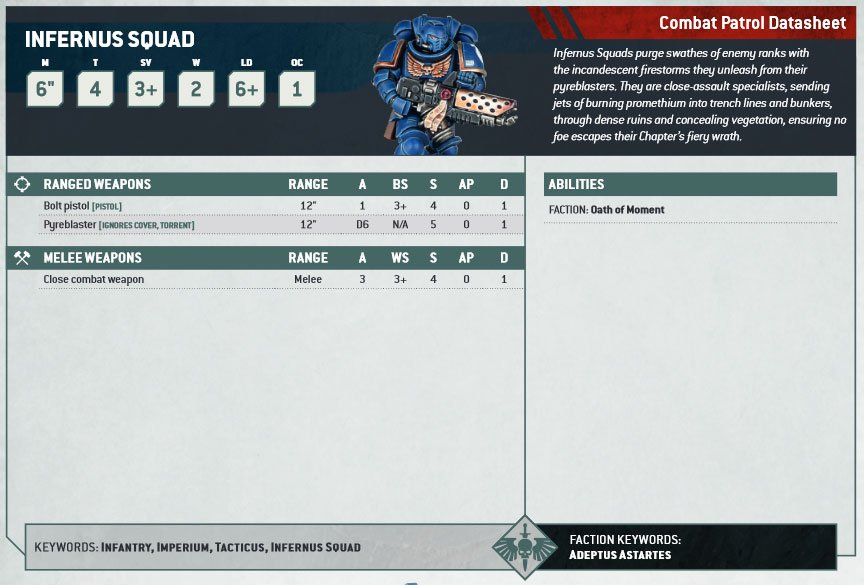
You will also notice that the abilities have been simplified into CORE, FACTION, and any abilities unique to that specific model. The faction abilities you can find specifically in the PDF are relevant to the combat patrol, whereas the core rules you can find in the Core Rulebook.
One slight thing that may go unnoticed is the little piece of flavour text in the top right of each card. It provides a little bit of lore about each unit and model as well as hints into how they should be used on the battlefield. The Warlord for each Combat Patrol is also a named character, allowing for some thematic storytelling should you choose.
Combat Patrol: Genestealer Cults example
So, let’s delve a little deeper and have a look at a specific Combat Patrol army to give us some context as to what these rule sets look like.
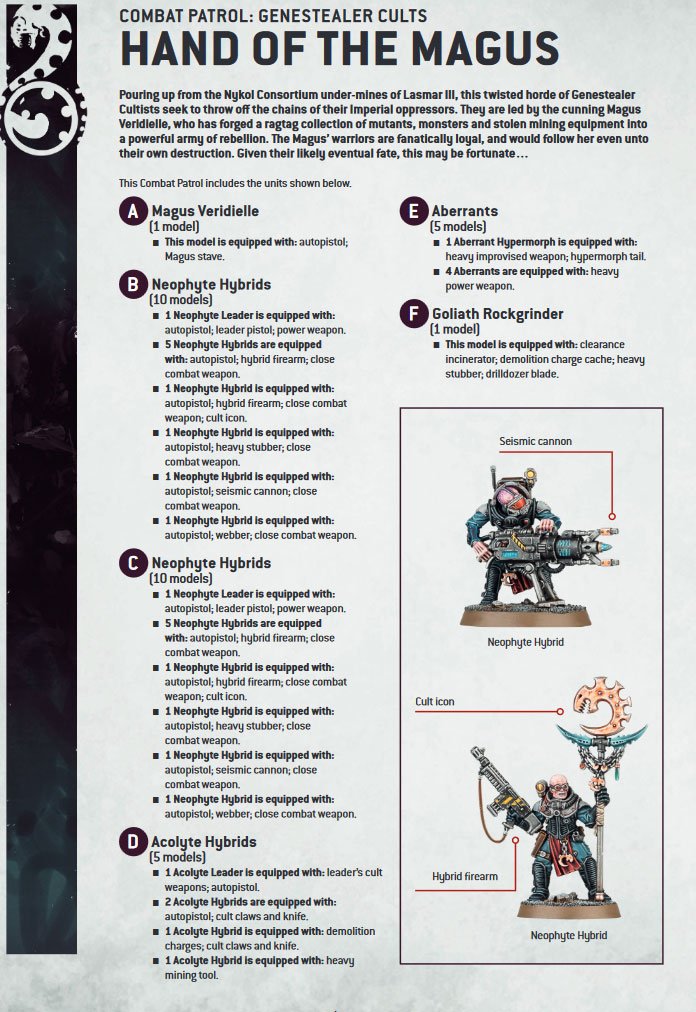
On the first page of the Genestealer Cults PDF, we are greeted by their army roster which is as follows:
- Magus Veridielle – A warlord equipped with a strong psychic melee weapon who has an ability that provides a +5 Feel No Pain roll against psychic attacks for any models in a unit she is leading.
- Neophyte Hybrids (2 squads of 10 models) – The core units of the Combat Patrol, armed with a diverse selection of weapons that will help them whittle away at any type of enemy they come across.
- Acolyte Hybrids (1 squad of 5 models) – Deadly close-combat units who have access to demolition charges, as well as the ability to re-roll 1s when hitting (and wounding if the target is within range of an objective marker), making them perfect for control objectives.
- Aberrants (1 squad of 5 models) – A strong close combat unit whose objective is simply to smash tough opponents with high attack/high damage melee weapons.
- Trituradora de rocas Goliat – Durable, fast, and with a range of different weapons, this vehicle can fulfil many different roles that may be required to support the advancing cultists.

As you can see, simply from looking at the roster, this army list has both a balance and a theme. Balance in the fact that it has units to hold the line, capture objectives, and break enemy lines – but themed in the sense that there is a slight focus towards close combat with these units.

Another useful added to these PDFs is a few labeled images that further illustrate specific weapons.

This theme is further expanded upon when you look at the Faction Rule for this Combat Patrol: The Cult Ambush. Putting it simply, when a unit of Neophyte or Acolyte Hybrids gets wiped out, there is a good chance that they can be redeployed somewhere else on the battlefield. Personally, I think this rule is great for the Genestealers as it encourages the player to be aggressive with their units while also giving the Combat Patrol a horde feeling to it even though there are a limited number of units on the battlefield.
The Enhancements you can give to your Magus further reflect this aggressive style of play. She has the choice of being equipped with either a Psionic Shield or a Resonance Stave. The first option allows her to provide the unit she is leading with a +1 to saving throws against ranged attacks while the second choice allows her to bonk enemy infantry with extra damage and fury – which synergies well with the Combat Patrol as a whole. A player could choose to have her lead the Aberrants with her Psionic Shield to keep them alive long enough so that they can get into melee. Or a player could decide for her to wield the Resonance Stave and group up with the Acolyte Hybrids to help give them a little extra punch when they get into melee.

Moving onto the secondary objectives, we see that the default choice, Rise Up, allows the Genestealer Cultists to gain Victory Points simply by having one or more Neophyte Hybrid units within range – regardless of who else is there! Combined with the Faction ability to basically respawn these units when they are wiped out, this makes hyper aggressive playstyles absolutely viable even when facing enemy armies that come with a lot of firepower or close combat prowess.
The Will of the Patriarch is the optional secondary objective which (while some would say is a little cheeky) allows you to ignore the objective markers somewhat and decide to turn your Magus into a makeshift one if she is in 3” of the centre of the battlefield. Though a bit more defensive than the previous secondary objective, it’s a great one to choose if you are up against an enemy that prefers to be well entrenched, and you want to force them out of their position.
The last thing to cover with the Genestealer Cults is the Stratagems, all of which continue to expand on the aggressive nature of their faction. Defend the Magus allows friendly units to reroll hit and wound rolls of one against enemy units in the Engagement Range of the Magus unit. Lurking Killers subtracts a 1 to hit rolls during enemy shooting attacks against one of the infantry squads. Then finally, Return to the Shadows, allows infantry to move 1d6 should an enemy get too close.
All these Stratagems combined create a strategic choice for the player, encouraging them to hit hard, fall back, or advance towards firing lines depending on what tactics are required for that turn.
Overall, it is my personal opinion that the combat patrol for the Genestealer Cult works well on both a mechanical I-want-to-win-the-game side of things as well as scratching that thematic itch that is common among a lot of players.
What’s really cool is that this focus on mechanical and thematic themes is present in varying degrees to all the combat patrols – so there is a good chance that whatever faction you want to play will be well represented!

40k Combat Patrol Rules by Faction — Playstyle Breakdown
Every Combat Patrol comes with its own unique faction rule, two enhancements, two secondary objectives, and a set of stratagems — all designed to capture that faction’s identity in a compact, balanced format. Here is a breakdown of what each Combat Patrol brings to the table and what kind of player each suits best.
Patrulla de Combate de los Marines Espaciales Rules
The Space Marines Combat Patrol is one of the most beginner-friendly options available. A Primaris Lieutenant leads Intercessors, Assault Intercessors, and a Redemptor Dreadnought — a well-rounded force with both shooting and melee capability. The faction rule lets units re-roll hit rolls of 1 while in Engagement Range, rewarding aggressive but calculated play. If you are new to 40k Combat Patrol and unsure which box to start with, Space Marines are hard to go wrong with. If you want more detail on which Space Marine army might suit you long-term, our Warhammer 40k Faction Overview covers every option in depth. → Buy the Space Marines Combat Patrol on Amazon
Patrulla de combate de la Guardia de la Muerte Rules
The Death Guard Combat Patrol is built around slow, relentless attrition. A Death Shroud Terminator Captain leads Plague Marines, Poxwalkers, and a Foetid Bloat-drone — a resilient force that is deeply difficult to remove from the board. The key faction rule is Contagion: as the game progresses, enemy units that remain near Death Guard models accumulate Contagion marks that increasingly debuff their saves and movement. The longer the game runs, the harder it becomes to stop the advance. This is the Combat Patrol for players who enjoy grinding down opponents over time rather than winning with speed or firepower. → Buy the Death Guard Combat Patrol on Amazon
Patrulla de Combate Necrones Rules
The Necrons Combat Patrol is built around one of the most distinctive mechanics in all of 40k: Protocolos de reanimación. Each command phase, Necron Warriors roll dice for every slain model — and on a successful roll, those models come back. An Overlord leads Necron Warriors, Canoptek Scarab Swarms, and Canoptek Wraiths, forming a force that holds objectives with maddening stubbornness. Opponents who focus fire on Necron Warriors often find them partially restored at the start of the next turn. This is the Combat Patrol for players who enjoy defensive, endurance-based gameplay — and for those who enjoy watching an opponent’s frustration grow each time a Warrior stands back up. → Buy the Necrons Combat Patrol on Amazon
T’au Empire Combat Patrol Rules
The T’au are a pure shooting faction — arguably the purest in the entire game. A Cadre Fireblade leads Fire Warriors and Pathfinders, supported by a Broadside Battlesuit. Pathfinders use Markerlights to designate targets, increasing hit chances for the rest of the patrol’s shooting. The T’au have virtually no close combat capability whatsoever — every strategy revolves around maintaining distance and layering fire. Best for players who enjoy methodical ranged tactics and who want to outshoot rather than out-fight their opponents.
Patrulla de Combate Tiránidos Rules
The Tyranid Combat Patrol captures the Hive Mind’s swarming nature. A Tyranid Prime leads Tyranid Warriors, Termagants, and a Carnifex. Synapse Creatures — the Prime and Warriors — keep nearby Termagants in coherent fighting order; push them out of synapse range and the swarm starts to falter. The Carnifex is your battering ram for crunching through anything in its path, while Termagants flood the battlefield and contest objectives. A mid-range swarm playstyle with a big, scary centrepiece model. → Buy the Tyranids Combat Patrol on Amazon
Blood Angels Combat Patrol Rules
Blood Angels are built for close combat. The Sed roja faction rule grants bonuses to wound rolls in Engagement Range, making the patrol hit harder the moment it reaches melee. Death Company and Assault Squads charge forward aggressively. This is a fast, all-in patrol that wants to be in close combat as soon as possible — not ideal for cautious players, but extremely satisfying when the charges land. → Buy the Blood Angels Combat Patrol on Amazon
Space Wolves Combat Patrol Rules
The Sons of Fenris bring ferocity and speed. Fenrisian Wolves and Blood Claws form a fast-moving assault force, with the Space Wolves faction rule adding additional punch to charge phases. Fenrisian Wolves can surge ahead to tie up enemy units while the infantry follows up. A close-combat patrol with more mobility than Blood Angels — great for players who want to charge and brawl but with a bit more tactical flexibility. → Buy the Space Wolves Combat Patrol on Amazon
Dark Angels Combat Patrol Rules
Dark Angels bring Deathwing Terminators, giving this Combat Patrol one of the lowest model counts but some of the toughest individual units. Unforgiven tactics reward methodical, disciplined play. Terminators with 2+ armour saves are extremely difficult to remove, and the patrol works best advancing steadily and using those Terminators as an immovable anvil. Best for patient, experienced players comfortable managing elite units. → Buy the Dark Angels Combat Patrol on Amazon
Black Templars Combat Patrol Rules
The Black Templars use a Vow system — each game you choose a crusade vow that modifies the patrol’s playstyle, favouring either melee, shooting, or resilience. Sword Brethren and Neophyte Initiates form a crusade warband that adapts based on the chosen vow and the opponent. A versatile patrol with meaningful decisions at the start of each game. Good for players who enjoy having options rather than a fixed playstyle. → Buy the Black Templars Combat Patrol on Amazon
Patrulla de Combate de los Caballeros Grises Rules
Every single model in the Grey Knights Combat Patrol is a powerful psyker. The patrol uses psychic abilities extensively, with units generating and spending Warp Charge to activate powerful effects. The model count is tiny — but each model is elite, well-armoured, and hits hard. Managing multiple special abilities per model simultaneously makes Grey Knights one of the more complex Combat Patrols to play well. Recommended for experienced players comfortable with layered rule interactions. → Buy the Grey Knights Combat Patrol on Amazon
Adeptus Custodes Combat Patrol Rules
The Custodes have the smallest model count of any Combat Patrol — but each model is one of the most powerful in the game. A Shield-Captain, Custodian Guard, and Vertus Praetors form a tiny elite force with 2+ saves and weapons capable of dismantling tanks. Losing even one model is significant. For players who enjoy the challenge of doing more with less, and who have experience managing elite units carefully, the Custodes Combat Patrol is uniquely rewarding. → Buy the Adeptus Custodes Combat Patrol on Amazon
Aeldari Combat Patrol Rules
The Aeldari use Hilos del destino — at the start of the game you roll a pool of dice and bank them, spending them throughout the match for re-rolls at critical moments. Combined with fast, fragile, high-damage units, the Aeldari patrol rewards forward planning and precise dice management. Move quickly, strike precisely, and never let the enemy dictate the pace. A high-skill patrol for players who enjoy strategic pre-planning. → Buy the Aeldari Combat Patrol on Amazon
Drukhari Combat Patrol Rules
The Drukhari use El poder del dolor — as the game progresses and casualties mount on both sides, the Dark Eldar grow progressively stronger. The patrol is built around speed: fast Raiders and mobile infantry that strike, retreat, and strike again. The Drukhari have minimal defensive ability and rely entirely on aggression and movement. A high-skill, high-reward patrol for players who enjoy complex mobile tactics and do not mind a steep learning curve. → Buy the Drukhari Combat Patrol on Amazon
Chaos Space Marines Combat Patrol Rules
A Dark Apostle leads Chaos Marines, Cultist Mobs, and Possessed in a flexible warband. The Pacts and Rites system gives a different tactical buff each turn depending on which dark gift you invoke — creating a shifting tactical game where you plan your pacts ahead based on the situation. Cultist Mobs provide cheap objective holders while Possessed and Chaos Marines deliver the damage. A good choice for players who enjoy tactical variance and do not want the same game twice. → Buy the Chaos Space Marines Combat Patrol on Amazon
Thousand Sons Combat Patrol Rules
All Thousand Sons infantry are psykers, making this one of the most psychic-heavy Combat Patrols available. The patrol uses Cabal Points — generated by psykers — to fuel powerful rituals that devastate opponents when timed correctly. The Thousand Sons play very differently from other Space Marine variants, functioning more like a wizard college than a standard Space Marine force. A high-skill patrol that rewards players who enjoy mastering complex activation sequences. → Buy the Thousand Sons Combat Patrol on Amazon
Chaos Daemons Combat Patrol Rules
A mixed daemonic force drawing from multiple Chaos gods. Warp Storm abilities and the Daemonic Corruption faction rule degrade enemy units that remain near daemon models over time. The patrol’s unpredictability is both its strength and weakness — games feel different each time. A thematic choice for players who enjoy the lore and are comfortable with a somewhat chaotic playstyle. → Buy the Chaos Daemons Combat Patrol on Amazon
Patrulla de Combate Orkos Rules
Mob Rule means Ork units fight better with more models — and worse as they start losing them. The Patrulla de Combate Orkos brings a Warboss, Boyz, and Gretchin in classic green tide style. Charge forward, hit hard, and replace casualties with sheer volume of attacks. Not the most tactically sophisticated patrol, but enormously fun to play — and a Warboss-led charge into melee is rarely anything other than spectacular. → Buy the Orks Combat Patrol on Amazon
Adepta Sororitas Combat Patrol Rules
Actos de fe allow the Sisters of Battle to perform miraculous extra actions once per turn — extra movement, an additional shooting phase, or bonus attacks in melee. Faith Points are spent to trigger these miracles, creating a resource management layer on top of normal play. The patrol rewards creative use of Acts of Faith to swing key moments. A uniquely structured patrol for players who enjoy resource management mechanics alongside standard 40k play. → Buy the Adepta Sororitas Combat Patrol on Amazon
Adeptus Mechanicus Combat Patrol Rules
Tech-Priests and Skitarii warriors follow the Omnissiah’s Blessing system, cycling through different blessings each turn that modify shooting, movement, or durability. The patrol is heavy on special weapons and has an unusual playstyle that does not map neatly to either pure shooting or pure melee. A thinking-player’s patrol that rewards understanding the blessing sequence and positioning units to maximise each turn’s active buff. → Buy the Adeptus Mechanicus Combat Patrol on Amazon
Patrulla de Combate de las Ligas de Votann Rules
The Leagues of Votann use Judgement Tokens — each time you target the same enemy unit with attacks, they accumulate tokens that give Votann units escalating bonuses to hit and wound against that target. The more consistently you focus fire on a single unit, the easier it becomes to destroy it. The patrol rewards concentrated, disciplined fire rather than spreading attacks across multiple targets. A methodical shooting faction with a satisfying feedback loop when the system clicks. → Buy the Leagues of Votann Combat Patrol on Amazon
World Eaters Combat Patrol Rules
The World Eaters live to charge. Khornate Berzerkers get bonuses in melee and can pile in and attack even when they are the ones being charged — turning defence into offence. The patrol has essentially no ranged game whatsoever and commits entirely to close combat. If the World Eaters reach melee, they are devastating. If they cannot reach melee, they struggle. An all-or-nothing patrol for players who want pure, unapologetic aggression. → Buy the World Eaters Combat Patrol on Amazon
Patrulla de combate Astra Militarum Rules
The Astra Militarum brings the most models of any Combat Patrol — multiple Infantry Squads, a Command Squad, and a Leman Russ Battle Tank. Orders from the Commander buff nearby units with re-rolls or additional movement, creating a command-and-control layer that rewards keeping units close together. The infantry are individually weak but collectively overwhelming. The Leman Russ provides the heavy firepower the infantry cannot. A horde-style patrol for players who enjoy coordinating large numbers of units. → Buy the Astra Militarum Combat Patrol on Amazon
Patrulla de Combate de los Cultos Genestealer Rules
We covered the Genestealer Cults in detail earlier in this article — see the full example breakdown above, including their Cult Ambush faction rule, Stratagems, and secondary objectives. In short: an aggressive horde patrol with the ability to respawn wiped-out units, making them uniquely difficult to remove from objectives permanently. → Buy the Genestealer Cults Combat Patrol on Amazon
Why would you play the 40k Combat Patrol Game mode?
Some of you reading this may have had a question pop up in your mind from time to time. If Combat Patrol is essentially a slightly streamlined version of the standard tabletop game of Warhammer 40k, why even bother with it?
That is a fair question to ask, especially if you have been in the hobby a long time and already have a good understanding of the rules, factions, and have an army or two yourself.
While Combat Patrol may struggle to tickle the fancy of some experienced players, there are many reasons why individuals both seasoned and new to the hobby may find this mode interesting.
Combat Patrol is a great way to try different factions without committing too much time and resources to collecting and painting. The Warhammer universe has so many interesting factions, each with its own compelling lore and all bringing something different to the tabletop experience. For a lot of players, they may have one army they spend the majority of their time playing and a secondary but smaller army they play as a change of pace.
No matter how you split it, keeping an army up to date by buying a new Codex and supplements, maintaining its competitive edge by buying new models and painting everything to an appropriate standard is a heavy drain on time and resources. While part and parcel of the hobby, this ultimately discourages players from branching out and trying to add a new army to their roster. The Combat Patrol box sets effectively cut out a lot of this, requiring a player to only assemble, paint, and stick in the back pocket to bring out whenever it takes their fancy.
Combat Patrol can be introduced at clubs to engage new players or by parents to get their kids involved. This point may not be applicable for the majority of players but let me explain.
My day job, when I’m not using my spectacular penmanship to bring you these lovely articles, I work in a school. During dinner times (or lunchtime if you’re from a part of the world that speaks “proper” English) at school, I run a little Warhammer 40k club. It’s a fun club to run and it’s nice to see the kids come in with their armies and enjoy their time. The only issue is, when a new child joins in and they have no army, I have to loan them some of my models so they can play.
Thankfully I have a lot of old space marine models from a while ago that I don’t use anymore, so it’s not a major problem. But what if I didn’t? What if I only had my wonderfully purple-painted Ork Kommandoz, or my snazzy pink World Eaters (I exclusively paint most things pink and purple) for them to play with? Teaching a child to play Warhammer is a wonderful experience, having them break a model that’s part of your main army, however, is not.
And I imagine for those of you who run clubs for adults, or you parents who want to introduce your hobby to your children, it may be very similar. Stick a couple of Combat Patrols into the mix however, and you’ve got a few armies that are ready to go without the emotional trauma that comes with watching someone think your carefully painted Shoota Boys are toys and so treat them as such. They are NOT toys! They are miniatures. Thank you very much.
Combat Patrol is an excellent choice for players with a hectic schedule. A lot of emphasis in the Combat Patrol game mode and 10th Edition at large is the streamlining of rules to make the game easier to engage with and less of a headache for new and old players alike.
But there is one type of player that often gets forgotten about in these overhauls. The 9-5 working man, the student doctor who is up to her eyeballs in work and study, the recovering alcoholic who puts a lot of effort into maintaining a dry lifestyle. If you’ve read my article on how to get ready for matched play, you’ll be familiar with the fact that playing Warhammer 40k is more than just collecting, painting, and playing. There’s planning your army composition, there’s taking the opponent’s army into consideration, there’s the tweaking of your forces with new units, and reflecting on your previous gameplay.
For a lot of people in the world, Warhammer is hard to access because, at the end of the day, we are just too tired to do all this extra stuff that comes with the game. Some people just want to play, and really who can blame them? I’m sure we’ve all felt like this from time to time (lord knows I’m in a constant state of “I just want to play, for goodness’s sake”) and if this game mode can allow these kinds of players to get some action on the tabletop, then I’m here for it.
Frequently Asked Questions — 40k Combat Patrol Rules
What is Combat Patrol in Warhammer 40,000?
Combat Patrol is a game mode where each player uses a single Combat Patrol starter box as their entire army. Each box comes with a free PDF ruleset from Games Workshop containing faction-specific rules, streamlined datasheets, stratagems, and secondary objectives — everything you need to play straight out of the box, with no Codex required.
How many points is a Combat Patrol army?
Combat Patrol armies are roughly equivalent to 500–600 points in standard 40k terms. Because each army is built from a fixed Combat Patrol box rather than a customisable points list, both players start balanced against each other automatically — no points calculator needed.
Do you need a Codex to play Combat Patrol?
No. Each Combat Patrol has its own free PDF ruleset available from Warhammer Community. These PDFs contain streamlined datasheets, faction rules, stratagems, and secondary objectives — everything you need to play, without the full Codex. This is one of Combat Patrol’s biggest advantages for new players and for experienced players trying out a new faction.
Can any Warhammer 40k faction play Combat Patrol?
Most major factions have a dedicated Combat Patrol box. Games Workshop has released over 20 Combat Patrol sets covering Space Marines, Necrons, Death Guard, T’au, Tyranids, Drukhari, Chaos Space Marines, and many more. A handful of smaller or newer factions do not yet have a dedicated box, but the range expands regularly.
Is Combat Patrol good for beginners?
Yes — Combat Patrol is one of the best entry points into Warhammer 40k. The fixed army composition removes the complexity of army building, the streamlined rules make learning faster, the smaller model count means less time painting before your first game, and the games themselves are shorter. If you are just starting out, we recommend checking our Warhammer 40k Beginner’s Guide alongside the Combat Patrol rules.
How long does a Combat Patrol game take?
A Combat Patrol game typically takes 45–90 minutes, compared to 2–3 hours for a standard 2,000-point game. The reduced model count and simplified rules make it significantly faster to play — one of the mode’s main selling points for busy hobbyists or for running back-to-back games at a club night.
What is the difference between Combat Patrol rules and standard 40k rules?
Combat Patrol uses simplified datasheets with fixed wargear (no equipment choices), a dedicated set of Combat Patrol missions, and faction-specific secondary objectives. The core mechanics — movement, shooting, charging, fighting — are identical to the standard game. Think of it as standard 40k with the army-building and list-tweaking layers removed.
Where can I find the Combat Patrol rules PDF for my faction?
Games Workshop provides free Combat Patrol PDFs for every faction on the Warhammer Community website. Search for your faction name plus “Combat Patrol PDF” on Warhammer Community and you will find the full rules document as a free download. These PDFs are updated periodically, so check back if your faction’s box has been refreshed.